
Tsugami Swiss Turning Machines
Tsugami's Swiss-style lathe lineup spans 3mm to 38mm in bar stock capacity across six series. That range matters because it means a single builder covers everything from high-volume precision production through complex 5-axis simultaneous machining. For precision shops in Oregon, Washington, and Northern Idaho that need to run aerospace, medical, and semiconductor work competitively, the capability spectrum available within one brand is a practical advantage.
What Is Swiss-Style Turning and When Does It Become Necessary?
Swiss-style turning is a CNC process that uses a sliding headstock and guide bush to support bar stock immediately behind the cutting tool throughout the operation. That support eliminates the deflection that limits conventional turning on long, slender, or small-diameter parts and allows the machine to hold tolerances that a conventional lathe cannot maintain reliably.
The other capability that defines Swiss turning is operational consolidation. A Swiss lathe can complete turning, milling, drilling, threading, and backworking in a single setup without re-fixturing. For complex parts with multiple features, that single-setup process eliminates the datum variation that accumulates each time a part moves between machines.
Chucker Convertible:
More Flexibility from One Machine
Standard Swiss machines run bar stock through a guide bushing, which optimizes support for long, slender parts but limits how short a part can be and how large a diameter can be run. The chucker convertible configuration changes that. By removing the guide bushing, the operator converts the machine to run shorter parts that cannot be gripped conventionally in Swiss mode, and opens up capacity for larger diameter stock than the sliding headstock configuration allows. For a shop running a mix of part lengths and sizes, that convertibility means more production flexibility from a single machine without adding a second platform to the floor.
Oscillation Cutting:
Chip Control on Hard Materials
Oscillation cutting is a Fanuc-based feature that adds a micro-oscillation to the axis motion during a cut. That controlled back-and-forth breaks the chip before it can build into a long, stringy coil that wraps around the tool or workpiece. The result is better chip control, longer tool life, and improved surface finish, particularly on tougher, high-hardness materials where chip management is one of the bigger production challenges. The feature runs through the Fanuc control, so operators already comfortable with Fanuc will find the experience familiar.
Modular Block Design:
Faster Changeover on the Cross Slide and Backworking Unit
Tsugami’s cross slide and backworking unit use a modular block design rather than a fixed, single-purpose tooling layout. Tooling blocks can be swapped, reconfigured, or added to as the part mix changes, instead of requiring a full retooling or a different machine configuration for each new job. For shops running a variety of part families, that modularity shortens changeover time and reduces the tooling inventory needed to support high-mix production. It also gives shops room to grow into more complex tooling setups on the same machine as their work evolves, without the cost of a structural rebuild.
Why Tsugami Covers More of the Capability Spectrum
Most Swiss lathe builders occupy a defined segment of the capability range. Tsugami spans the full range within a single brand, from high-volume precision production through complex 5-axis simultaneous machining. Four series are most relevant to aerospace, medical, and semiconductor work in this region.
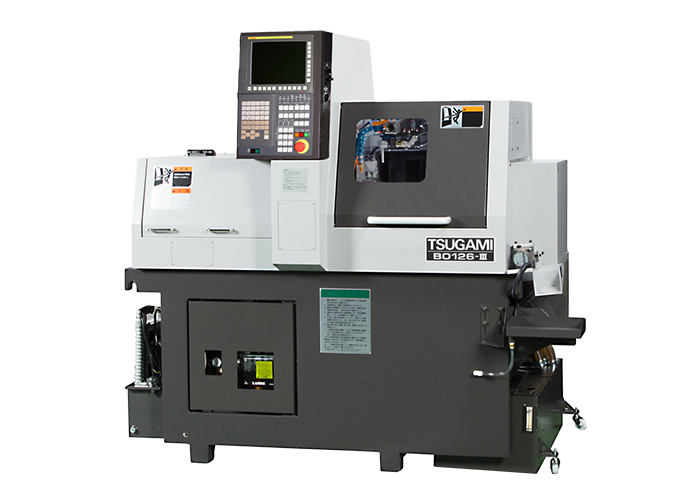
The B-Axis Series
The B-Axis Series adds live-tool B-axis capability to Swiss turning. When a part requires contoured or sculpted geometries that standard Swiss tooling cannot reach, the B-Axis series handles those features in the same setup. For aerospace and medical parts where re-fixturing introduces datum variation, keeping the operation in a single setup is both a quality and throughput advantage.
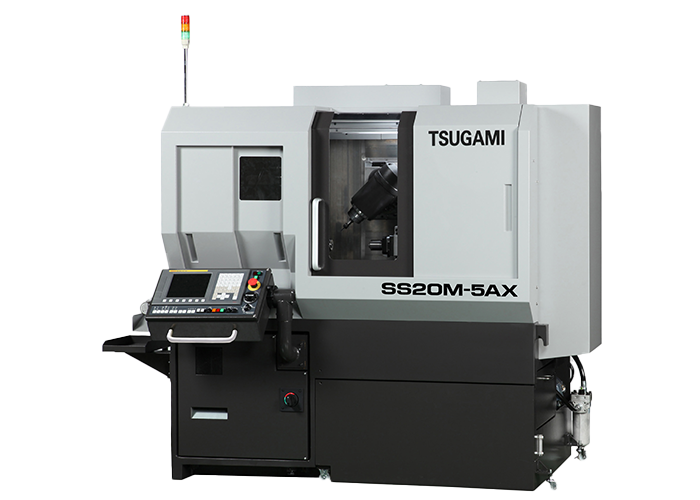
The Multifunction Series
The Multifunction Series handles the most demanding single-setup applications. Thread whirling, inclined milling, tapping, and drilling are all available in a single compact machine, with bar stock capacity up to 38mm. For semiconductor, medical, and advanced aerospace work where geometric complexity is the constraint, the Multifunction series handles parts that most Swiss machines cannot complete in a single setup.
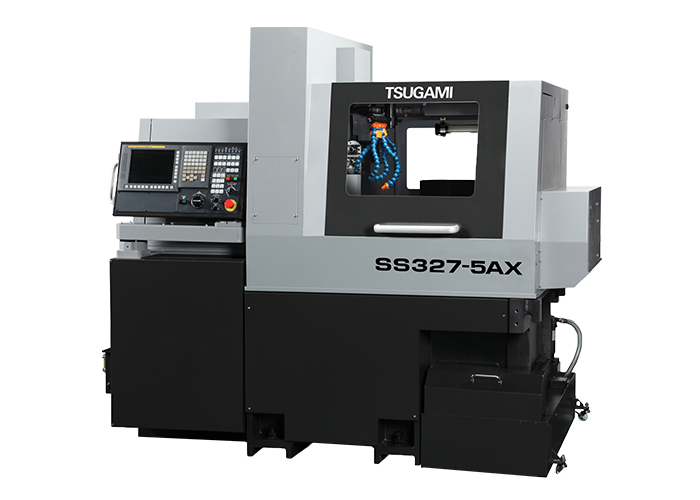
The Opposed Gang Tool Series
The Opposed Gang Tool Series is the right platform for high-volume precision production where throughput and accuracy need to coexist. Up to 38mm bar capacity in chucker mode, 32mm in sliding headstock (Swiss) mode, with high-rigidity construction and a broad range of tooling configurations.
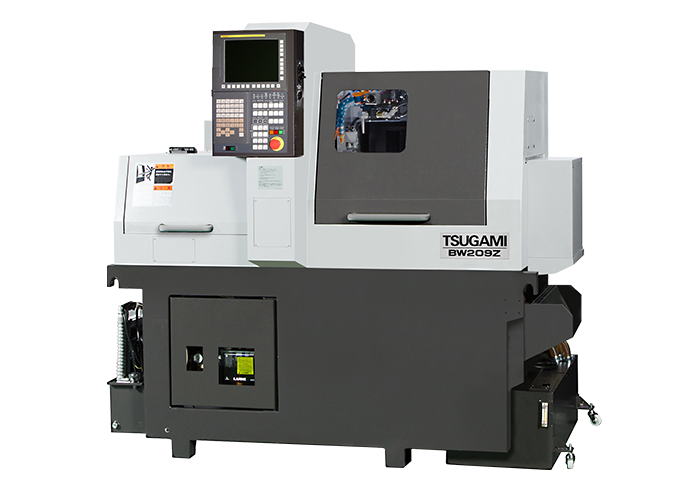
The Independent Gang Slide Series
The Independent Gang Slide Series offers simultaneous three-way control across the main spindle, sub spindle, and gang tool plates. For semiconductor and electronics manufacturers running high-mix, small-diameter work where changeover time matters, this architecture delivers production-machine throughput with the flexibility to handle part variety without a changeover penalty.
Aerospace:
When Tolerances Are Set by the Print
Aerospace suppliers working with Tier 1 primes produce parts where the tolerance conversation ends at the print. A second setup introduces a second datum, and a second datum introduces positional variation. The Tsugami B-Axis series eliminates that second setup for parts with contoured geometries.
Medical:
Single-Setup Precision on Parts Where Scrap Has a Real Cost
The Tsugami Multifunction series removes the intermediate operations. Thread whirling, inclined milling, and precision turning happen in a single setup against a single datum. The variation that accumulates across multiple setups in a conventional process is not present in a single-setup Tsugami process.
Semiconductor and Electronics:
High-Mix Without the Changeover Cost
The Tsugami Independent Gang Slide series provides simultaneous three-way control. For semiconductor and electronics manufacturers running a wide variety of small-diameter components, that combination of throughput and flexibility is difficult to replicate on conventional equipment.
Choosing the Right Tsugami Series
Application | Series | Bar Capacity | Key Capability |
|---|---|---|---|
Contoured aerospace and medical | B-Axis | Up to 20mm | Live-tool B-axis in single setup |
Complex single-setup applications | Multifunction | Up to 38mm | Thread whirling, inclined milling, 5-axis |
High-volume precision production | Opposed Gang Tool | Up to 38mm (chucker) / 32mm (Swiss) | High rigidity, broad tooling range |
High-mix semiconductor and electronics | Independent Gang Slide | Up to 29mm | 3-way simultaneous control |
FAQ Section
What is the Tsugami Swiss lathe lineup?
Tsugami produces Swiss-style CNC lathes across six series covering bar stock diameters from 3mm through 38mm. The lineup includes the B-Axis series for contoured 5-axis work, the Multifunction series for complex single-setup applications including thread whirling, the Opposed Gang Tool series for high-volume production, and the Independent Gang Slide series for high-mix semiconductor work.
What is thread whirling in Swiss CNC machining?
Thread whirling is a process used to produce thread profiles on small-diameter workpieces in a single pass. A whirling ring with multiple cutting inserts rotates around the workpiece while the workpiece rotates slowly in the opposite direction. The process produces thread geometries including bone screw threads faster than conventional single-point threading, and is particularly effective on titanium and stainless steel.
Why do semiconductor manufacturers use Swiss-type turning?
Semiconductor and electronics component manufacturing involves small-diameter precision parts produced in high volumes with frequent part-family changes. Swiss turning handles the tight tolerances and surface finish requirements, while platforms like the Tsugami Independent Gang Slide series add changeover flexibility for high-mix environments.
Ready to Run Your Most Complex Parts in a Single Setup?
Whether you're producing aerospace components with tight geometry requirements, medical parts where scrap has a real cost, or semiconductor work that demands high-mix flexibility, Ellison Technologies can help you identify the right Tsugami series for your application. Our team can evaluate your current process and show you where single-setup Swiss turning changes the equation.