How do you know when it's time to add a CNC machine?
You're pushing out delivery dates or turning down work. If you're quoting longer lead times to protect the schedule, the schedule is telling you something.
Overtime has become the capacity plan.
Extra shifts can cover a spike. When they become permanent, they often cost more than a machine payment and wear out your best people.
Setups take more spindle time than cutting.
If machines sit idle while operators flip parts, change fixtures, or move work between machines, you're paying for capacity you can't use.
Older machines can't hold tolerance on newer work.
When jobs get routed around certain machines, or every part needs extra inspection, the machine has become the bottleneck.
You can't staff another shift, but the work is there. Higher-output machines and automation let the team you have produce more without hiring.
If two or more of these sound familiar, adding a machine is likely cheaper than the work you're leaving on the table.
How do you choose the right CNC machine for your work?
The right machine starts with the parts you make most and the parts you want to win next.
Vertical machining centers are the all-around workhorse for job shops and production milling. They handle plates, housings, brackets, and moderate volumes, they're easy to load and program, and they're the most accessible entry point.
Horizontal machining centers make sense as volume grows. Pallet changers let operators load one pallet while the other cuts, tombstone fixtures hold multiple parts at once, and chips fall away from the work for better finishes and tool life. They're built for production parts with features on several sides.
5-axis machining centers pay off when a part needs three or more setups on a 3-axis machine, or has complex surfaces and angled features. Machining five sides in one setup cuts handling, fixturing, and the tolerance stack-up that comes with every re-clamp.
Turning centers and mill-turns handle round parts. Live tooling and Y-axis let a lathe drill, mill, and tap in the same cycle. Multi-turret and mill-turn machines go further, finishing complex parts in one setup that would otherwise travel from a lathe to a mill to a drill press.
Automation belongs in the conversation when parts repeat or when you have more work than operators. Bar feeders, pallet systems, Automatic Workpiece Changers, and robot cells add spindle hours through breaks, shifts, and nights.
A quick way to start: list your top 10 parts by revenue and count the setups and machines each one touches. The parts with the most handling usually point to your next machine.
What does a CNC machine actually cost over its lifetime?
Two machines with similar prices can cost very differently over their lives. Before you compare quotes, compare:
- Cycle time and setups per part: Fewer setups mean less labor and less scrap risk.
- Uptime and service response: A machine that's down for a week waiting on a technician or a part erases a lot of savings.
- Tool life: Rigidity and spindle performance show up in your tooling budget.
- Labor per part: Automation and done-in-one machining change how many people each part needs.
- Cash flow: Financing terms decide when the machine starts paying for itself.
The number that matters is cost per part, not price per machine.
What should you ask a CNC machine distributor before you buy?
The machine is only half the decision. Before you sign, ask your distributor these questions, and make sure the answers are specific. Here's how Ellison answers them.
Will your applications team help prove out my part and cycle time before I buy? At Ellison, yes. Our applications team works through your part and process before you commit.
What training comes with the machine, for both operators and programmers? Ellison trains your operators and programmers on every DN Solutions machine we install.
How fast does your service team respond, and where are your technicians based? Ellison has 16 locations, so a service technician is never far from your shop.
How quickly can I get spare parts? Ellison's service and parts team supports every DN Solutions machine we sell, from 16 locations.
Can you integrate automation and support the cell after installation? Ellison integrates AWCs, bar feeders, pallet systems, and cobots as one working cell, and supports it after installation.
What financing options are available? Ellison Financing Services offers flexible terms, including deferred-payment programs on approved credit.
The answers decide how fast a new machine starts making money and how long it keeps doing it.
What it looks like in practice
Bryant Machine was running a high-volume part through three operations on three machines: turning on a lathe, a cross hole on a vertical mill, and manual tapping. A DN Solutions turning center with live tooling consolidated all three into one setup and cut cycle time 60% on a part the shop makes about 4,000 times a year.
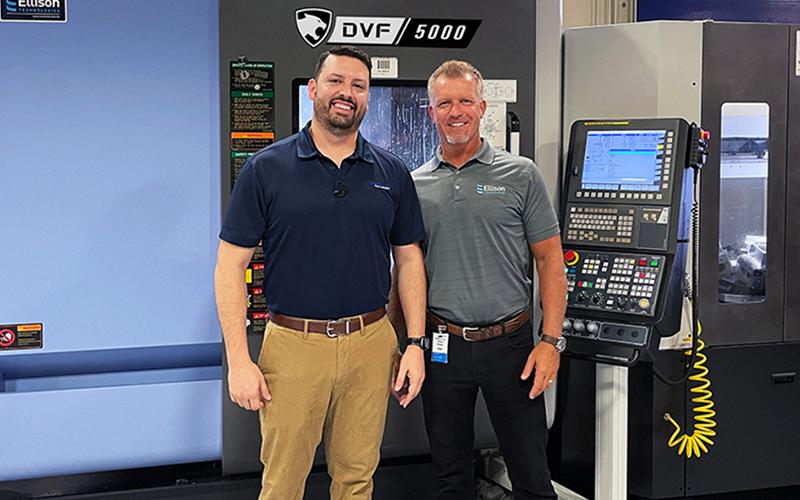
Geospace Technologies needed to machine more complex parts with fewer setups. A DN Solutions DVF 5000 with an 8-pallet Automatic Workpiece Changer took setups from five to two, cut cycle time from 1.5 hours to 45 minutes, and lets the machine run unattended.
Both started with the same question: what's actually slowing the part down?
Find the right machine for your shop
Ellison Technologies has helped manufacturers answer these questions since 1955. Explore the DN Solutions lineup, from compact vertical machining centers and production lathes to 5-axis, mill-turn, and metal additive, on our Why DN Solutions page, or talk with us about the parts you're making and the capacity you need.
Call: (866) 292-0460 Email: cncinfo@ellisontechnologies.com