
Okamoto machines are exclusively available through Ellison Technologies in the following states:
California, Wisconsin, North Carolina, Tennessee, Oregon, Washington, Georgia, Alabama, Mississippi, South Carolina and Virginia.
Cylindrical / Internal grinding is the process that decides whether a precision cylindrical part ships or gets scrapped.
Turning and boring get you close. Grinding gets you to the finish line. For shops working with tight-tolerance bores, shafts, and bearing surfaces, the ability to grind in-house is often the difference between controlling your quality and hoping a vendor does it for you.
This post covers what Cylindrical and Internal grinding actually are, when they become necessary, what it costs a shop to go without that capability, and how to evaluate which grinding platform fits the work on your floor.
What Is Cylindrical Grinding?
Cylindrical grinding, or outside diameter grinding, is a precision machining process that removes material from the external surface of a cylindrical workpiece using an abrasive wheel. The part rotates on its axis while the grinding wheel engages the outer surface, removing small amounts of material to achieve a precise diameter, surface finish, and geometry.
Cylindrical grinding is used when turning cannot hold the required tolerance, when surface finish requirements exceed what a turning operation can produce, or when the material is too hard to turn reliably. Ground diameters can hold tolerances of ±0.0001 inches or tighter, with surface finishes in the range of 8 to 16 microinch Ra depending on the wheel specification and process setup.
Common Cylindrical grinding applications include shafts, spindles, rolls, pins, hydraulic cylinders, and any cylindrical component where fit, finish, and dimensional accuracy are critical to function.
What Is Internal Grinding?
Internal grinding, or inside diameter grinding, removes material from the internal bore of a workpiece. A small-diameter grinding wheel rotates at high speed inside the bore while the part is held in a chuck. The process corrects bore geometry, improves surface finish, and achieves tolerances that boring and honing cannot always reach on hard materials or tight-tolerance applications.
Internal grinding is the process of choice for precision bores in bearing housings, hydraulic components, dies, bushings, and any application where the internal geometry of a cylindrical feature determines how the part functions in assembly.
The challenge with Internal grinding is the wheel diameter. The grinding wheel must fit inside the bore with enough clearance to operate, which limits wheel size and therefore grinding efficiency on small bores. For large internal diameters, Internal grinding is fast and highly capable. For very small bores, specialized equipment and careful process setup are required.
Cylindrical vs. Internal vs. Universal Grinding: What Is the Difference?
Many modern grinding machines combine cylindrical and internal capabilities in a single platform, which is where the term universal grinding comes from. A universal Cylindrical / Internal grinder can handle external diameters, internal bores, and face grinding, even at angular displacements, in a single setup, reducing part handling and the accumulated error that comes from re-fixturing a part between operations.
The tradeoff is complexity. A dedicated cylindrical grinder optimized for a specific range of shaft diameters will often be faster and more rigid on that specific work than a universal machine doing the same job. For shops with a defined, repeatable work mix, dedicated machines can make sense. For shops running a variety of cylindrical parts across different geometries, a universal platform offers more flexibility.
The right answer depends on what you are making, how much of it, and how your current workflow handles the re-fixturing that universal grinding eliminates.
When Cylindrical / Internal Grinding Becomes Necessary
Most shops reach a point where turning and boring are not enough. The signals tend to be consistent:
Tolerances the turning process cannot hold.
If your print calls for a bore diameter within ±0.0002 inches or a shaft diameter within ±0.0001 inches, and your turning center is struggling to hold it reliably across a full run, grinding is the process you need. Thermal variation in a turning center, tool wear, and workholding compliance all introduce variation that grinding eliminates.
Hard materials that resist turning.
Hardened steels, tool steels, aerospace and other exotic alloys, and ceramics cannot be turned to a finish that meets tight-tolerance requirements. Grinding is the only practical process for finishing these materials to precise dimensions.
Surface finish requirements below what turning can produce.
Bearing surfaces, seal journals, and mating cylindrical features often require surface finishes in the range of 8 to 32 microinch Ra. Turning can get close on soft materials, but grinding achieves it reliably on any material.
Outsourcing that is slowing you down.
If cylindrical grinding is a regular step in your process and you are sending those parts out, you are giving up control of lead time, quality, and margin on every one of them. Bringing that operation in-house is a capacity and cost conversation as much as a capability one.
Distortion correction after heat treatment.
Parts that go through heat treatment come back dimensionally changed. Bore diameters close, shaft diameters change, and features that were in spec before the oven are often out of spec after it. Grinding is how you correct that distortion and bring the part back to print.
This last application is where 4M Precision Grinding, one of Ellison Technologies' Okamoto customers, built an entire business. Founded by Rubén Medina in 2011, 4M specializes in correcting bearing ring distortion caused by machining and heat treatment processes.
Through our grinding process, we are able to correct bearing ring distortion that occurs during machining and heat treat process," said Medina.
The work requires consistent accuracy on thin-walled, high-value components across thin-section bearing ring grinding on parts up to 18 inches in diameter. That is not work you can do without the right grinding equipment.
What It Costs to Go Without Grinding Capability
Shops that outsource grinding or turn away work that requires it tend to see the cost in a few specific places.
Scrap and rework on tolerance-critical parts.
If the turning process is doing the job of a grinding process, first-part yield suffers. Parts that come in at the edge of tolerance or outside it mean rework time, material waste, and schedule pressure. On high-value components, one scrapped part can erase the margin on several good ones.
Lead time exposure from outsourcing.
Sending parts to an outside grinding vendor adds days or weeks to the process, depending on the vendor's capacity. That lead time is outside your control. When a customer needs a faster turn or a rush order comes in, you are at the mercy of someone else's schedule.
Work you cannot quote.
If your shop does not have grinding capability, you are not bidding on jobs that require it. That is a cap on the complexity and value of work you can pursue. Shops that bring grinding in-house typically find new categories of work open up quickly, because they can now quote the complete process rather than referring a customer elsewhere for finishing.
Margin compression on outsourced operations.
Every time a part leaves the building for grinding, someone else is capturing margin on that operation. Over a year of production, that accumulates into a meaningful number.
The Okamoto Cylindrical /Internal Grinding Lineup
Okamoto has built a reputation for precision surface and cylindrical grinding machines that hold accuracy across long production runs. For shops evaluating their first cylindrical /internal grinding investment or expanding existing capability, the Okamoto lineup covers a range of configurations.
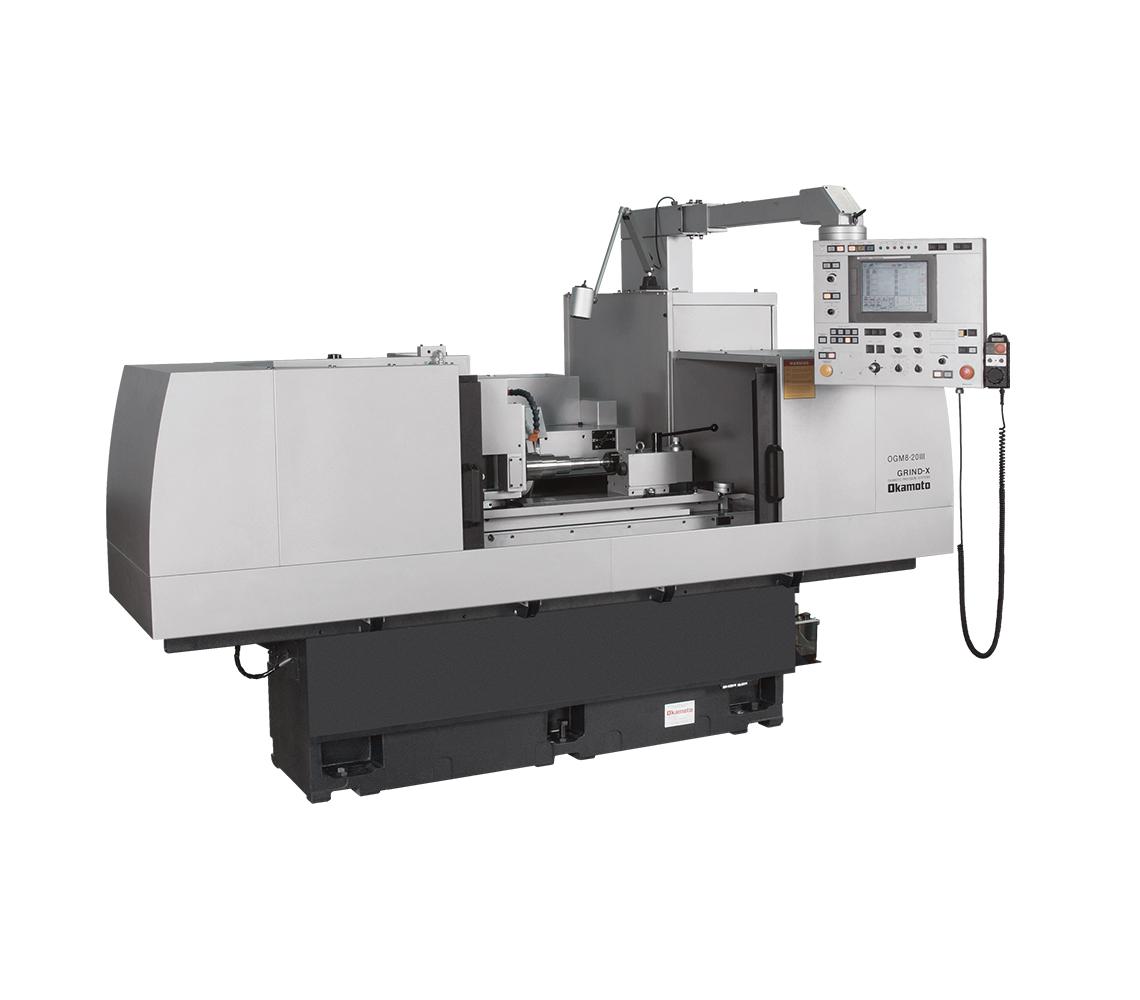
OGM-820UIII: Flexible Cylindrical Grinding with Operator Control
An entry point into precision cylindrical grinding for shops running varied part runs. The OGM-820UIII handles cylindrical grinding between centers or in chucking mode with MDI (Manual Data Input) control, a maximum grinding diameter of approximately 7.9 inches (200 mm), and a maximum grinding length of approximately 20 inches (500 mm). The 16-inch wheel provides good stock removal capability for the machine's class. This platform suits shops that need to improve accuracy and reduce rework on a mix of cylindrical parts without committing to full CNC automation.
OGM-1220UNCIII: CNC Cylindrical Grinding for High-Precision Production
For shops running production volumes where consistency matters as much as capability, the OGM-1220UNCIII brings CNC control, multi-step grinding cycles, and automated operation to cylindrical grinding. Maximum grinding diameter of approximately 12 inches (300 mm), maximum grinding length of approximately 20 inches (500 mm), and a 20-inch wheel. CNC control removes operator-to-operator variation and allows repeatable cycle programming across production runs, which is where per-part quality consistency is won or lost.
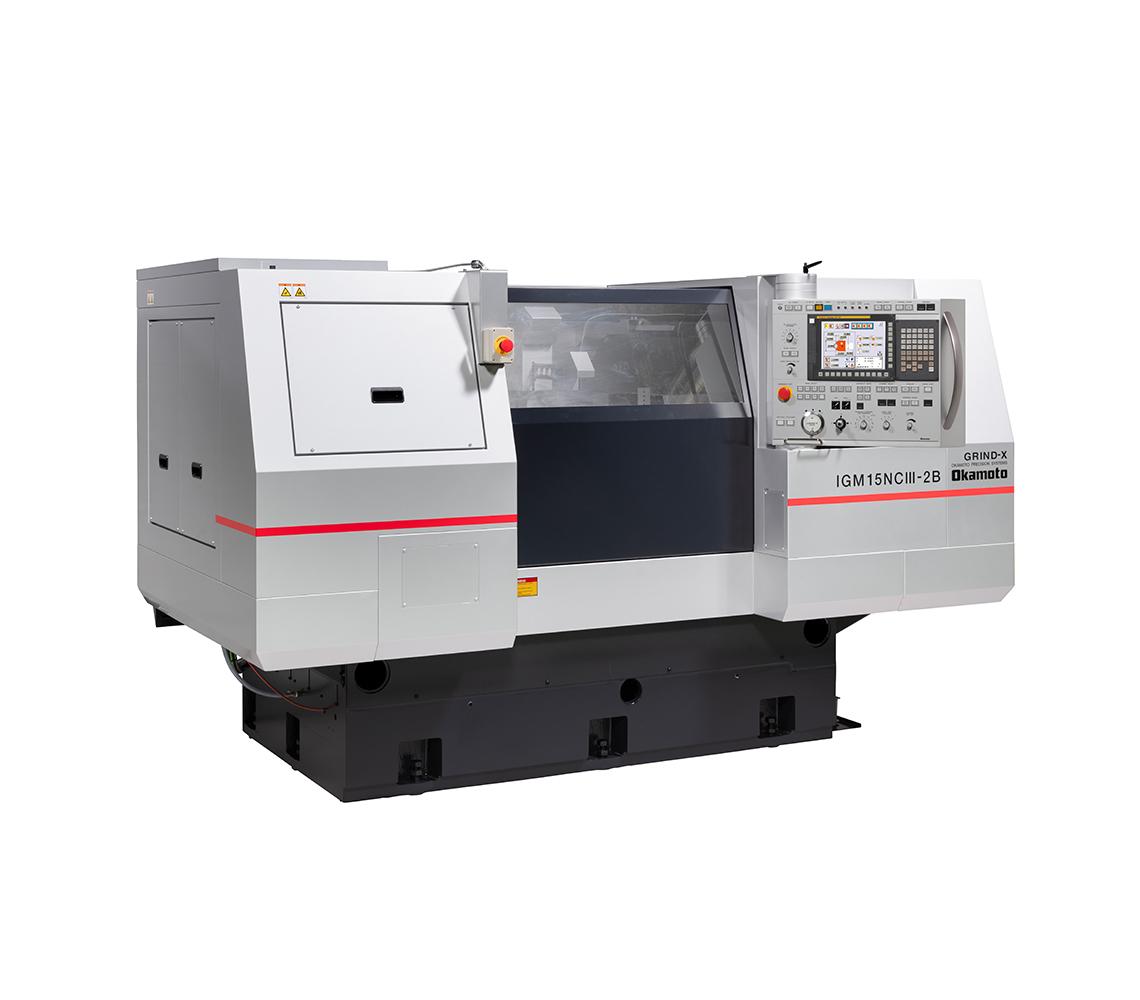
IGM-15NCIII/2B: Twin-Spindle ID Grinding for Complex
The IGM-15NCIII/2B is a CNC Cylindrical / Internal/face grinder with a twin-spindle configuration and a maximum work diameter of approximately 15 inches (400 mm). The twin-spindle setup allows multiple internal grinding operations in a single setup, which reduces cycle time and eliminates the re-fixturing error that stacks up when a part moves between machines. This is the right machine for shops running complex bore geometries on high-value components where every setup transition is a quality risk.
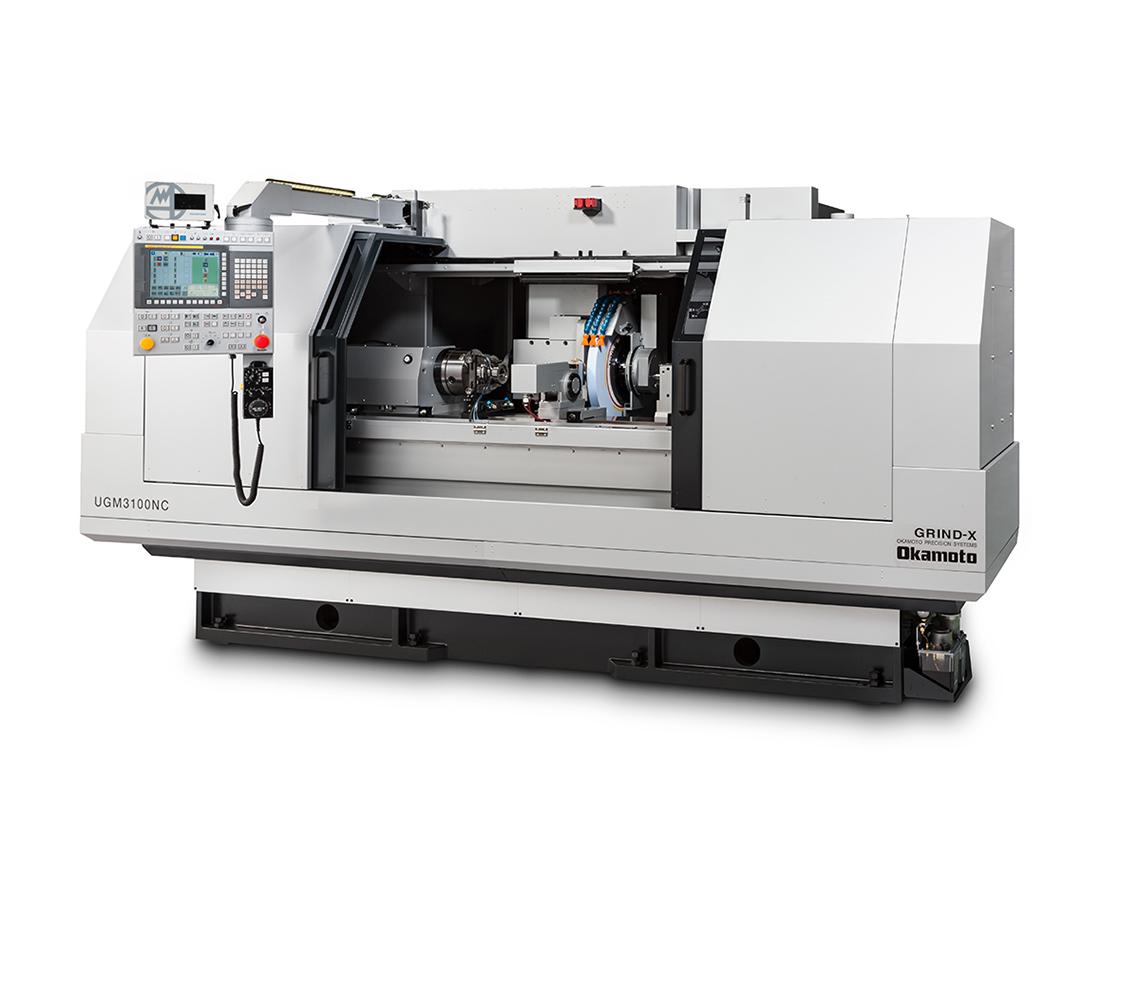
UGM-1224NC: Multi-Function Cylindrical / Internal Grinding in One Platform
The UGM-1224NC combines Cylindrical and Internal grinding on a multi-spindle turret with CNC control. Maximum grinding diameter of approximately 12 inches (300 mm), maximum grinding length of approximately 24 inches (600 mm). For shops that need both external and internal grinding capability without the footprint of two separate machines, the UGM-1224NC consolidates those processes. Fewer setups, faster delivery, and more flexibility on mixed part types.
How to Evaluate Whether Grinding Is the Right Next Step
Bringing Cylindrical / Internal grinding in-house is a capital decision, and it makes sense to evaluate it the way you would any other one. A few questions that tend to clarify the picture quickly:
What work are you currently outsourcing for grinding? If you have a reliable list of jobs that go to an outside vendor for cylindrical finishing, that is your baseline. The cost of that outsourcing, plus the lead time it adds, is the floor for the ROI calculation on an in-house machine.
What work are you turning away? Jobs you cannot quote because you lack the capability are harder to quantify but often larger than the outsourcing number. If your sales team is regularly losing bids on complex cylindrical work, that is worth estimating.
What is your scrap rate on tolerance-critical turned parts? If turning is being pushed to do a grinding job, the scrap rate reflects it. That cost belongs in the grinding ROI calculation.
What materials are you cutting? If hardened steels or other difficult-to-cut materials are part of your regular work mix, grinding may already be a requirement on some jobs rather than an option.
Okamoto and Ellison Technologies can help you work through this evaluation for your specific situation. We work with shops at every stage of grinding capability, from their first Cylindrical grinder to multi-machine grinding cells, and the Okamoto lineup covers that full range.
FAQ Section
What is Cylindrical / Internal grinding?
Cylindrical grinding (outside diameter grinding) removes material from the external surface of a cylindrical part to achieve a precise diameter, geometry, and surface finish. Internal grinding (inside diameter grinding) does the same for internal bores. Both processes use abrasive wheels rotating at high speed and are used when turning or boring cannot achieve the required tolerance or surface finish, or when the material is too hard to cut by conventional means.
What tolerances can Cylindrical / Internal grinding hold?
Precision Cylindrical and Internal grinding can hold diameter tolerances of ±0.0001 inches or tighter under controlled conditions, with surface finishes in the range of 8 to 16 microinch Ra. The achievable tolerance depends on machine rigidity, wheel specification, workholding, and process setup. For bearing-quality work, tolerances in the range of 0.0001 to 0.0002 inches are routine on well-maintained grinding equipment.
When should a shop bring Cylindrical / Internal grinding in-house?
When outsourcing grinding regularly enough that lead time or cost is a constraint, when turning processes are struggling to hold required tolerances, when scrap rates on cylindrical parts are higher than acceptable, or when the shop is regularly declining work that requires grinding capability. Any one of these is a signal worth investigating. Together they make a compelling case.
What is the difference between OD grinding and cylindrical grinding?
Cylindrical grinding is the broader category. OD grinding is a type of cylindrical grinding that works on external diameters. ID grinding works on internal bores. Universal or multi-function grinders can handle both in a single setup.
What Okamoto grinding machines does Ellison Technologies carry?
Ellison Technologies carries a range of Okamoto cylindrical grinding machines including the OGM-820UIII (manual OD grinding), OGM-1220UNCIII (CNC OD grinding), IGM-15NCIII/2B (twin-spindle ID/OD/face grinding), and UGM-1224NC (multi-function OD/ID grinding) among others. Each platform is suited to different combinations of part size, volume, and process complexity. Contact your local Ellison team for current availability and specifications for your application.
How do I know which Okamoto grinding machine is right for my shop
The right machine depends on the diameter and length of the parts you grind, whether your work is primarily Cylindrical, Internal, or both, your production volume and the degree of automation that justifies, and whether you need flexibility across varied part types or consistency on a defined production run. Ellison Technologies offers grinding process reviews to help shops answer these questions before making a machine decision.
Want to know if Cylindrical / Internal grinding belongs in your shop
Request a grinding process review with your local Ellison Technologies team or explore the full Okamoto lineup.